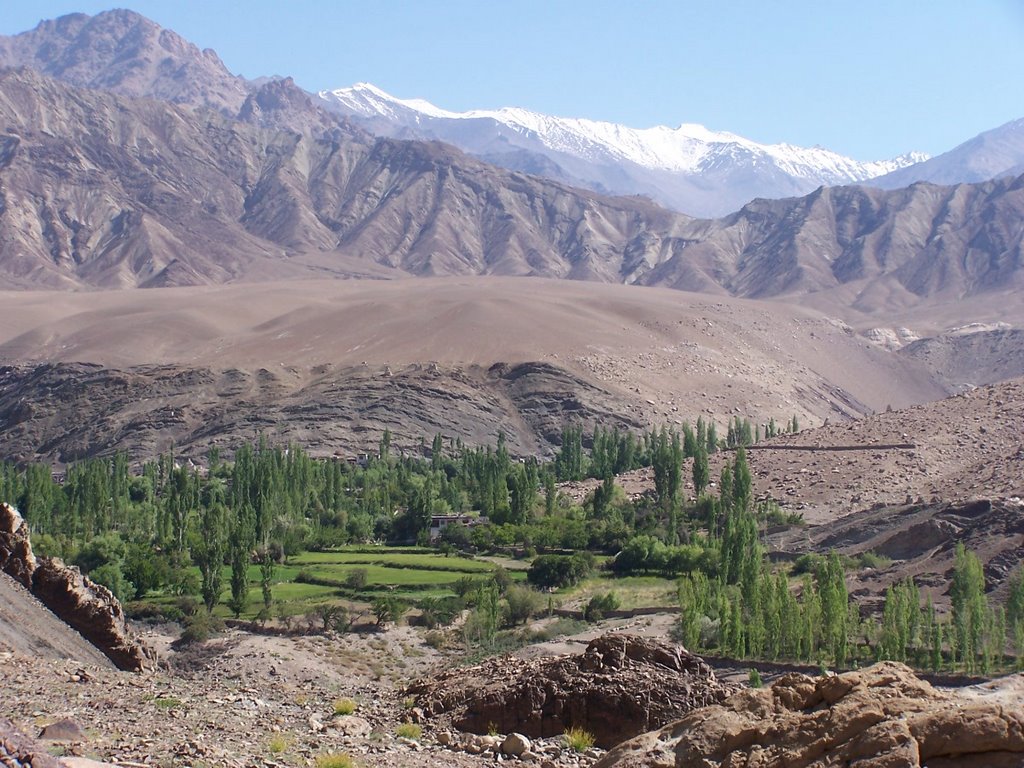
As you get closer to the fort itself, it really does seem like a story book. Inside are winding streets, bazaars, Hindu and Jain temples, a palace and havelis.
 I stayed at a small guest house inside the fort. First night there was no room so I slept on the roof which was okay because it was a lovely night, clear and cool. Below is the lane that leads to the guest house entrance. As usual one must navigate around the livestock, auto rickshaws, booths that sell stuff to tourists and not be distracted by the signage.
 The view from the roof top of the guest house was magnificent.
 ...... with architecture that was very traditional and carved from wood and golden sandstone. Founded in 1156, Jaisalmer had a strategic position on the camel-train routes between India and Central Asia which brought it great wealth.
 Do consider "clicking" on these images to enlarge them. You can then better see the incredible, intricate carving of the sand stone.
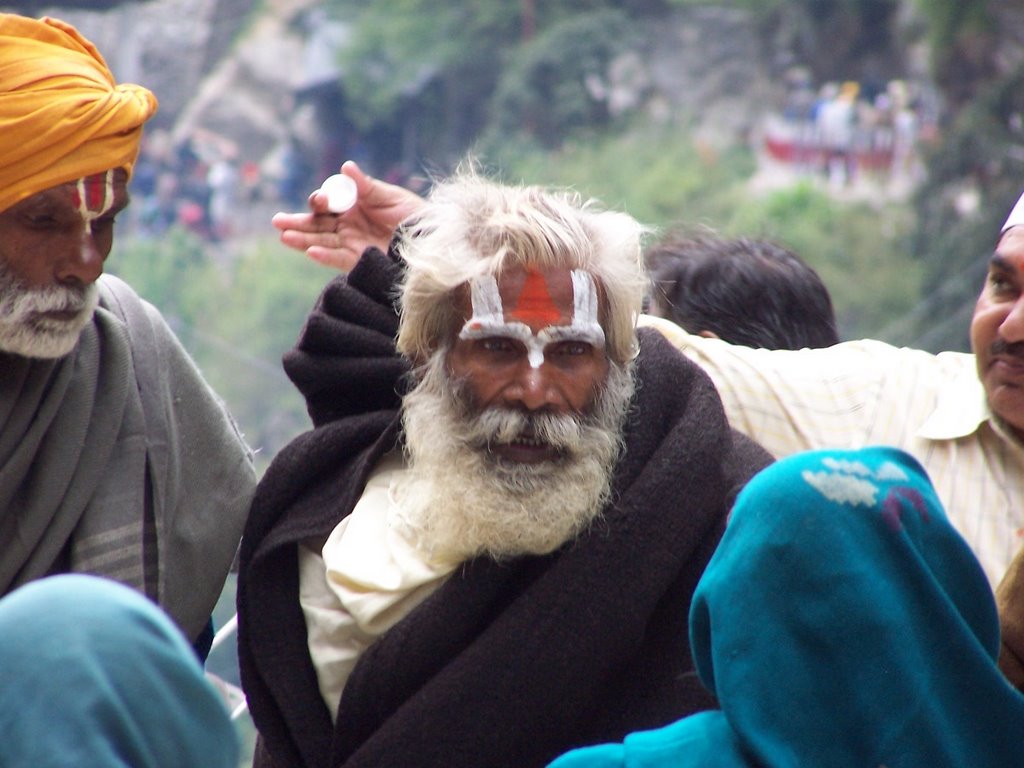
 Turbans are the name of the game in Rajasthan and no where are they more prolific than in Jaisalmer. The colourful turban tradition among the men of this state contrasts with the parched, burnt land, much of which borders the Thar Desert. The dramatic colour and styles of the Rajasthan turban reveals caste, what a man does for a living and where he comes from.


This man fixed my sandal. He came along the street at a point when I was particularly aggravated with my shoe and starting to look for a cobbler in one of the shops. Very convenient in deed!

The women wear a lot of jewellery and ornaments worn in the nose can be small or significant! A local street scene.
 I met a fellow who invited me to a Hindu wedding. It was happening that evening and since I had nothing better to do I took him up on the offer. Below is an over head view of the wedding feast preparations in the empty lot, next door to the house and tent that would host the festivities.
 This lady (below) was the aunt of the bride and a person who was described as "tribal". In other words, she was not from the town of Jaisalmer but rather from the desert and had married a "towny". She was very friendly, however at times she could be quite fierce.
 Her son who had great eyes and a charming smile.
 A wedding reveller sharing a joke with me. Or at least I think it was a joke. Given that I did not speak their language, the rolling of the eyes could have been at something I did.!!
More turbans. When do I get mine?
The groom. Very serious.
The bride. Looking not real happy. Getting married is a serious undertaking and these two young people (bride is 18 years old, groom probably not much older) have never met each other until tonight. The party started in the early evening, with the actual ceremony taking place about midnight and lasting a good two hours. Things were still going on at 5:00a.m.
 **************************************************************************************
Motorcycle Madness. Some of you already know and for those of you that don't, I bought a motorcycle in India and planned to do some travelling on it in order to get off the beaten path and out of the tourist spots. It had been my intention to have it sent up to Rajasthan but when that did not work out, I went to Cochin, Kerala in southern India to pick it up.
Behold the beast. An 1972 Enfield Bullet.
 I left Cochin which is on the south western coast of of Kerala and drove north on National Highway 17. Along the way you could see canals or "backwaters" with Chinese fishing nets suspended over them. William Dalrymple wrote of Kerala: "It is the greenest state in India: hot and humid, still and brooding. The soil is so fertile that as you drift up the lotus-choked waterways, the trees close in around you, as twisting tropical fan vaults of palm and bamboo arch together in the forest canopy. Mango trees hang heavy over the fishermen's skiffs; pepper vines creep through the fronds of the waterside papaya orchards." I think the two photos below sort of represent this sentiment.
 After about 400kms you leave Kerala and enter the state of Karnataka. It is the eighth largest state in India, both in area and population and is situated on the westen edge of the Deccan Plateau. Bangalore (call-centre central) is its capital. Another 250kms up the coast and you reach the town of Gokarn, a Hindu pilgrim centre and quiet beach town. Below is a photo of "Koorti Teertha" the large temple tank, where locals, pilgrims and immaculately dressed Brahmins perform the ablutions and worship on the ghats.
 At the nearby Ganapati Temple, which honours the role Ganesh played in rescuing the Shiva lingam housed in another nearby temple, are two gargantuan chariots made of wood which barrel down the main street during the Shivaratri Festival. I was there for the some of the week long festival but could not stay for the race down the street.
 A local "holy cow" with his musician friend.
 He (or she) was really cute.
 A couple of local school girls....
 Who were creating a mandala-like design outside their front door in the evening. Many people do this in the town and I believe it is a welcoming sign for the house.
 As mentioned, Gokarn is a beach town and there are many, many lovely beaches along the coast of Karnataka. Most of the ones around Gokarn can only be reached on foot. No roads which means no vehicular traffic. It makes them really nice and quiet.
 Of course, you do have to share your space...
 While at the beach one day there was a Bollywood movie being shot. This is the hero (below) and he is suppose to be a fisherman. They were trying to teach him how to throw the net but it was taking a lot of time for him to learn. I took this photo just as the director yelled "Action!".
 *********************************************************************************
Hampi. Almost 300kms inland from the coast is the village of Hampi. It is a grueling drive across the Deccan Plain where temperatures soared to almost 40 degrees celcius and the wind swept across the plain. "The landscape and ruins of Vijayanagar, near the village of Hampi, are some of the most fascinating in India. They're set in a strange and sublime boulder-strewn landscape that resonates with a magical air. Vijayanagar was once the capital of one of the largest Hindu empires in Indian history. Founded in 1336 and hit the peak of its power in the 16th century. It camed to a sudden end in 1565 when the city was ransacked by a confederacy of Deccan sultanates." (source Lonely Planet)
There are hundreds of ruins to see amid the large boulders.

 Hemakuta Hill has a scattering of early ruins including Jain temples and...
 a monolithic sculpture of Narasimha (Vishnu in his man-lion incarnation) which is almost 7 metres tall.
 Just a shot of a woman drying her sari which she had just washed in the river.
Panoramic view of ruins at sunset
Quirky house / temple built into boulder on top of a hill Local monkeys. They are nasty creatures and I am not a fan of them either!
 The area has a few well tended enclosures which contain structures like this delicately designed pavilion called the "Lotus Mahal" and....
 ... the Elephant Stables which is a grand building with domed chambers and, yes, elephants once resided here.
 Probably one of the most famous sites is the Vittala Temple which is a UNESCO World Heritage site. The entire complex is very large. This is an ornate stone chariot in the temple courtyard. Its wheels were reportedly once capable of turning.
Leaving Hampi, I headed west back out to the coast and north to Goa. On this particular day we completed 400kms on the bikes. A regular day would be about 150kms. The sun is strong, temperatures high (30 - 40 degrees celcius), plenty of dust and pot holes. Hence I wore jeans, jean jacket, bandanna and handkerchief across my face. Leave very little exposed.

Not much to report about Goa. Below are a couple of gypsy women at the Friday market in Mapusa. 
To return to Cochin, I took the train and had the bike shipped. Below, the local railway station guys are wrapping the bike for the journey south.

 So that's the end of the travels in India for 2008. By bike I did about 1,600kms over a period of 3 weeks. The rest was by plane, train, and car.
*********************************************************************************
Singapore. I hopped a 4 hour flight to visit a cousin who had recently moved there. Singapore is the complete antithesis of India. It is clean and orderly. It can be expensive. It is one giant sauna at any time of the year. It is only 1° north of the equator. Temperatures average around 31°C during the day and linger around 24°C at night., 365 days of the year. There are about 4 million people who live there and it was a good rest from the madness of South Asia.
 It has a Chinese, Malay and Indian heritage. Below is a very large and modern Buddhist "Temple of the Tooth Relic"
 The roof top had the most gorgeous orchid garden (see below). Note the two Buddhist monks taking a photo of the flowers. Many places you go in Singapore have these fantastic flowers. You can spend many hours in the Bontanical Gardens viewing them and many other plants. I would recommend a visit to both this temple and the SBG if you visit the city.

 The Singapore Zoo is truly world class. I was so impressed by it. Below are some of its residents.
  White tigers...


 After a week in Singapore it was not quite time to return to India so I headed to Thailand for a few days entertainment.